Nothing but hot air
How a dutch inventor revolutionized the world of cooking with nothing but “hot air”
Once upon a time, being accused of being "full of hot air" was an insult.
Politicians were full of hot air. Advertisers were full of hot air. Talk-show executives and managers certainly were. "Hot air" stood for grand promises with little substance behind them. Then a Dutch engineer came along and turned hot air into one of the most successful kitchen appliances of our time. The Airfryer may well be the world's only billion-dollar idea that is made almost entirely of hot air. The man behind it was Fred van der Weij. And although millions of people use his invention every single day, very few know the name of the innovator who made it possible.
The Quiet Inventor from Almere
Fred van der Weij was born in the Netherlands in the early 1960s and later lived in Almere, the planned city just outside Amsterdam. He was never a charismatic entrepreneur or the stereotypical startup founder wearing a hoodie and pitching investors. Quite the opposite.Those who knew him describe a quiet, analytical engineer—someone who preferred solving technical problems to promoting himself. A man who loved the atmosphere of a workshop and approached engineering challenges the way others solve crossword puzzles.
From an early stage of his career, van der Weij worked in electronics and product development, constantly experimenting with new technical solutions. The general public had never heard of him—and he probably preferred it that way. Fred van der Weij belonged to that rare breed of inventors who are driven less by fame than by the desire to solve a problem. In his case, that problem had a surprisingly simple name: French fries.
The French Fry Problem
The story did not begin in a state-of-the-art laboratory. Not in Silicon Valley. Not even in a professional restaurant kitchen. It began with greasy, soggy French fries —and one simple question: How can you make food crispy without drowning it in oil?
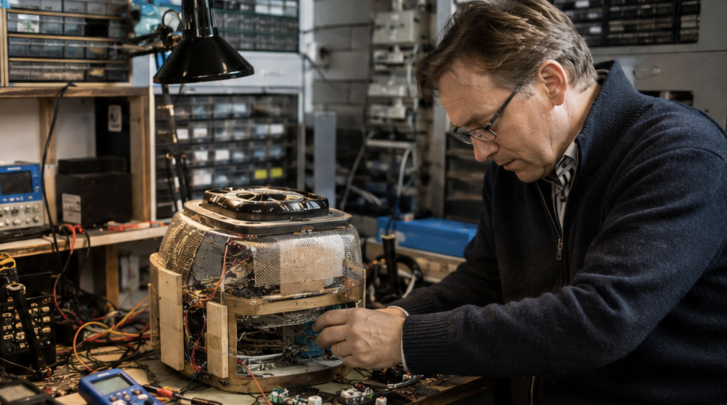
In the early 2000s, van der Weij began experimenting in his workshop. According to later accounts, his first prototypes looked like a strange combination of a doghouse, a space heater and a failed DIY project. Wooden panels. Wire mesh. Aluminium parts. The results? Burnt on the outside. Frozen on the inside. Most people would have given up. He kept going.
Somewhere between airflow, temperature and cooking time, van der Weij discovered something remarkable. If hot air circulates fast enough, it can replace much of the oil required for frying. Not emotionally. Physically. And that simple insight would eventually create an entirely new billion-dollar market.
The Engineer Behind Rapid Air Technology
In 2005, Fred van der Weij patented his invention. The underlying principle sounds deceptively simple but requires remarkable engineering precision: Extremely fast circulation of hot air inside a compact cooking chamber. The air was not meant merely to heat food. It had to surround it evenly and move quickly enough to create the crispy, golden-brown exterior people normally associate with deep frying. Van der Weij later called the system Rapid Air Technology.
It sounds like a marketing slogan today. Back then, it was simply engineering terminology. Eventually, Philips recognized the potential of the invention. In 2010, the company introduced the world's first commercial Airfryer at the IFA consumer electronics trade show in Berlin. The rest is kitchen history.
The Revolution on the Kitchen Counter
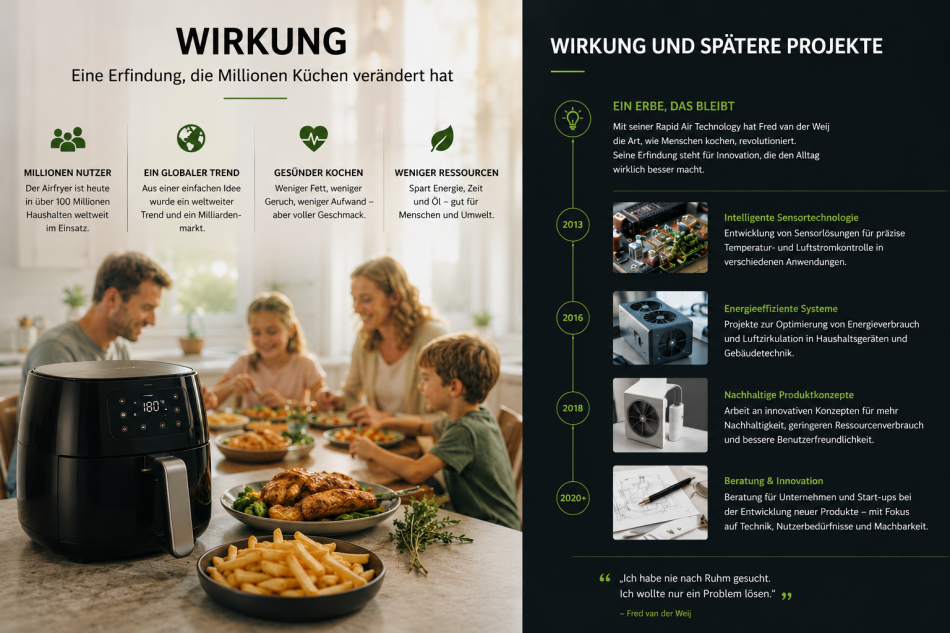
The Airfryer arrived at exactly the right historical moment. People wanted to eat healthier. Cook faster. Use less electricity. Consume less fat. Spend less time in the kitchen. The Airfryer delivered exactly that.
Then the trend exploded. TikTok discovered Airfryer recipes. Supermarkets began printing "Airfryer suitable" on food packaging. Fitness influencers praised crispy chicken wings without deep frying. Singles prepared dinner in it. Families cooked complete meals. Students cooked... almost everything. The world fell in love with hot air.
The Most Remarkable Part? The Inventor Never Became a Superstar.
This is where the story becomes truly fascinating. Fred van der Weij never became the Steve Jobs of the kitchen world. He did not build a global corporation. He did not burn through millions in venture capital. He was never celebrated on startup stages around the world. No glamorous personal brand. No billion-dollar empire.
Yes, he earned money from his invention. Philips licensed his technology, and Dutch reports suggest he "made a very good deal." He likely became financially comfortable. But the real billions were earned later by the industry that grew around his invention: Global manufacturers. Retailers. Accessory companies. Food brands. Almost everyone knows the product. Hardly anyone knows its inventor.
Perhaps that is the real point of the story. We live in an age obsessed with innovation. With startups. Disruption. Scaling. The next big thing. Founders are celebrated on conference stages. Investors applaud visions and pitch decks as though they were already successful products.
It recalls the famous question often asked during investment pitches: "What do you have that we don't?"
The answer is not marketing. capital. or buzzwords.
The answer is simply: the person behind the technology.
That was Fred van der Weij. The most important innovations often emerge not where people talk the most about innovation. Some people burn investor money. Others solve real problems. Fred van der Weij belonged firmly to the second group. Somewhere in a modest workshop in the Netherlands, an engineer was simply trying to make better French fries. In doing so, he transformed millions of kitchens around the world.
Perhaps the Airfryer Says More About Our Time Than We Realize
Because the Airfryer does not merely sell food. It sells a way of life. Pleasure without guilt. Flavor without fat. Convenience without effort. Speed without compromise. Modern society packaged inside a kitchen appliance. And perhaps that is the greatest irony of all: That "hot air" eventually proved to have far more substance than many of the grand promises of our age.
Fred van der Weij died of cancer in 2022.
But his idea lives on.
Every time an Airfryer clicks shut, hot air races through its compact cooking chamber, and someone thinks: "Why not? A few more fries won't hurt."
Fred van der Weij
Fred van der Weij was a Dutch engineer, product developer, and the inventor of the Airfryer. His invention revolutionized frying by using rapidly circulating hot air instead of large amounts of oil, becoming a worldwide success. He passed away in 2022 at the age of 61.
Key Facts
Born: c. 1961, Almere, the Netherlands
Died: 2022, Echten, Friesland, the Netherlands
Company: APDS Development BV (Applied Product Development Services)
Known for: Inventing the Airfryer (commercialized with Philips in 2010)
Profession: Mechanical engineer and product developer
Early Career and Education
Van der Weij studied Mechanical Engineering at the MTS (Middle Technical School) in Breda and completed additional studies in business administration and engineering. From the mid-1980s onward, he worked in product development and CAD programming. Through his company, APDS Development BV, he specialized in applied product development and rapid prototyping, including the use of emerging 3D-printing technologies.
Inventing the Airfryer
In 2005, van der Weij began experimenting with a way to cook French fries without using oil. After developing several prototypes, he succeeded in creating a system that combined a heating element with a high-speed fan, allowing food to become crispy through rapidly circulating hot air.
In 2010, the appliance was introduced to the market in partnership with Philips. The brand name Airfryer quickly gained worldwide recognition and has since become synonymous with hot-air fryers.
Impact and Later Projects
The Airfryer helped millions of households move away from traditional deep fryers and established itself as a healthier, cleaner, and more convenient alternative.
Beyond his best-known invention, van der Weij remained actively involved in innovation projects. During the COVID-19 pandemic, for example, he developed 3D-printed solutions designed to help reduce the spread of the virus.
Legacy
Fred van der Weij is remembered as a creative, practical-minded engineer whose invention inspired an entirely new approach to home cooking.
By combining engineering excellence with everyday practicality, he transformed the global kitchen appliance industry and left a lasting legacy that continues to shape the way millions of people cook today.
Author
Katja Peteratzinger is an International Business Graduate (FH) specializing in Marketing, a certified expert within the RKW Hessen Business Consultants Network, an entrepreneur and a publisher. She is a Regional Value Creator and the driving force behind the Power Regions initiative.
© All rights reserved. Images: AI-generated.
Contact
Hof Gnadenthal 3, 65597 Hünfelden, Germany
Phone: +49 (0)6438 91097
Email: AnFncHRrYWdCcmd2Z3BjdnhrbGVncC9yd2Bua3Fqa2xlLGZn@nospam
Websites
www.peteratzinger-publishing.de
www.powerregionen.de
www.katjapeteratzinger.de
The Nest Is Getting Uncomfortable – On Self-Efficacy and Entrepreneurship
17.08.2026
Why an uncomfortable nest can sometimes be exactly what we need: about self-efficacy, entrepreneurship and personal responsibility – and why we grow when not every obstacle is removed from our path, when we learn to trust in our own abilities and those of others, and that powerful experience, that moment of realizing: "I can do this".
The Regional Value Creator Index - What Would Your Region Be Without Your Business?
15.08.2026

Many self-employed people in Germany have considered leaving the country in recent years. That is alarming. The 2026 Self-Employment Report paints a concerning picture: 38 percent of respondents have considered emigrating, and nearly six percent already have concrete plans.
But do we actually know how much a business is worth to the region it calls home?
That is exactly why we created the Regional Value Creator Index.
How a Dutch Inventor Turned Nothing but Hot Air into a Billion-Dollar Idea
30.06.2026
Not long ago, telling someone they were “full of hot air” was an insult. Then a Dutch engineer came along and turned nothing but hot air into a billion-dollar idea.
His invention—the Airfryer, or hot air fryer—has become one of the most successful kitchen appliances of our time. The man behind it was Fred van der Weij. Yet although millions of people use his invention every day, very few know the name of this remarkable European innovator.
